

The circular economy as defined by the Ellen Macarthur Foundation is a system where materials never become waste and nature is regenerated. In a circular economy, products and materials are kept in circulation through processes such as maintenance, reuse, repair or refurbishment, recycling, and composting. The circular economy tackles climate change and other global challenges such as biodiversity loss, waste, and pollution, by reducing our use of finite resources.
The circular economy is based on three principles:
- Eliminate waste and pollution
- Circulate products and materials (at their highest value)
- Regenerate nature
‘In our current economy, we take materials from the Earth, make products from them, and eventually throw them away as waste – the process is linear. In a circular economy, by contrast, we stop waste being produced in the first place.’ Ellen MacArthur Foundation
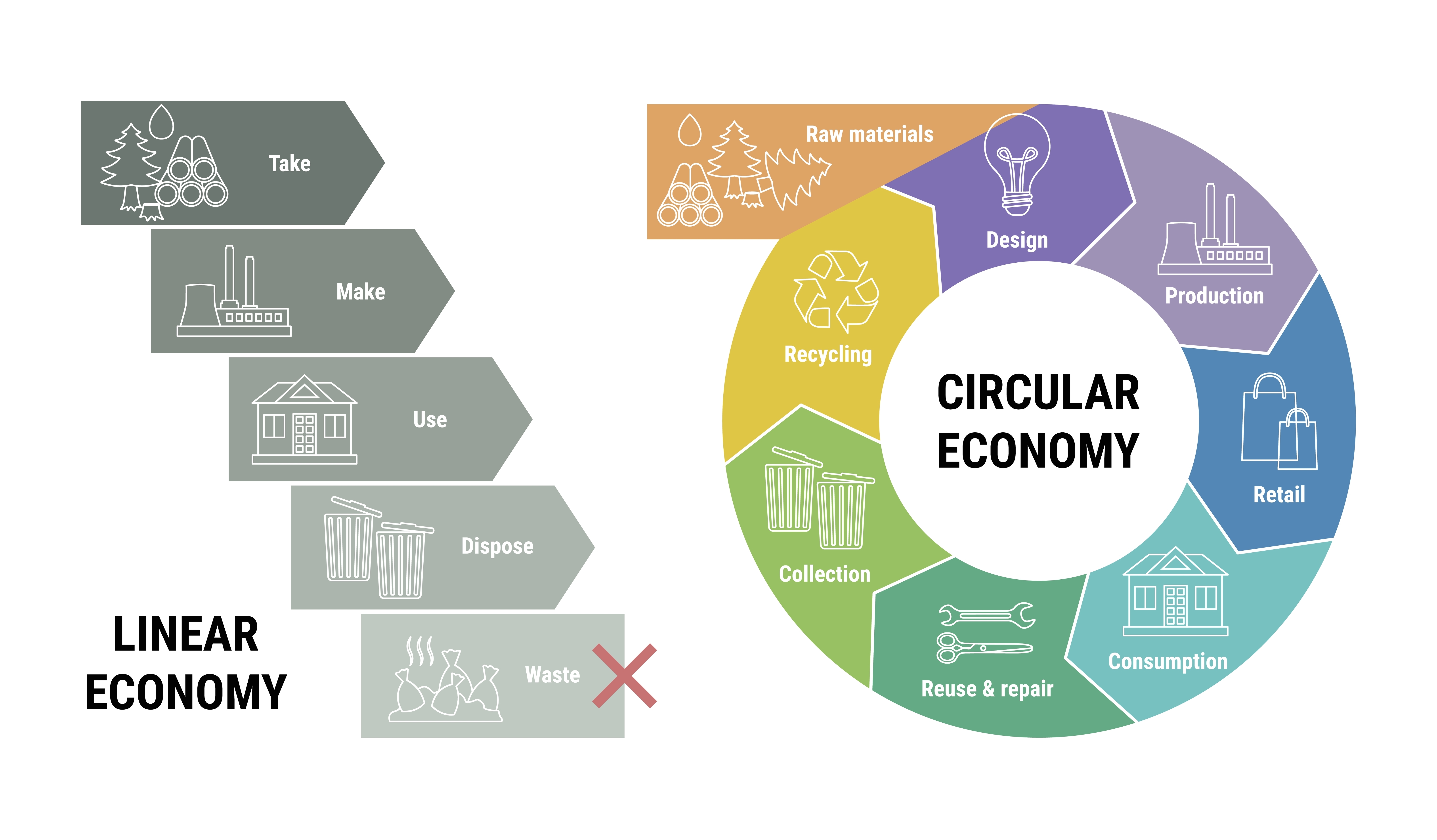
There are a variety of actions we can take in our lives to support the development of a circular economy and reduce our environmental impact.
Avoid
Avoiding waste can take some pre-planning, investment, and changes to daily routines, however it is a powerful way to support a circular economy - and new behaviours often quickly become habit. We have divided up waste avoidance into several categories: behaviours, tools, skills, and networks.
Avoidance behaviours:
Changing some of our habits can make a big difference in reducing waste. Examples of waste avoidance behaviours include:
- Conducting a fridge and pantry audit before meal planning for the week to use up leftover food and avoid overbuying
- Choosing to dine in instead of ordering takeaway
- Bringing your own container when dining out for leftovers
- Saying no to items you don’t need, such as freebies at events
- Freezing or preserving excess produce or leftover meals
- Shopping at bulk food stores or farmers’ markets where you can buy unpackaged items
Avoidance tools:
Identify items which are disposed after just one or two uses and invest in an option where you can reuse over and over again. For example:
- Reusable coffee/drink cup
- Reusable menstrual products
- Reusable nappies
- Reusable cutlery
- Reusable food storage containers or bees wax wraps
- Reusable baking mats
- Reusable incontinence products
- Reusable water bottle
- Reusable makeup halos or cloths
- Reusable party kit
Avoidance skills:
Extend the life of items by regular maintenance and timely repairs. Don’t have the skills yourself? Visit the City of Joondalup Repair Lab and have our volunteer technicians help out, visit the Mindful Mending events at Duncraig Library, join the Joondalup Men’s Shed (Women’s Shed also running during select hours) or find an external course to build your skills.
Avoidance networks:
The old saying one person’s trash is another’s treasure is still applicable today! There are several ways we can conveniently gift, share, donate or sell unwanted items:
- Buy Nothing Groups: a community gifting platform. Join your local area’s Buy Nothing Group on Facebook to gift unwanted items or request to be considered for items gifted by others.
- Online marketplaces: items can be sold or listed as free on Facebook Marketplace, Gumtree, eBay or other online marketplaces.
- Charity organisations: quality items can be donated to charity stores via donation bins or even picked up from your home via their collection services. Find out more in the ‘Gift and reuse’ section on our Waste Initiatives page or head directly to a charity website.
Recover
Waste recovery is capturing waste at the point of disposal to turn it back into a usable resource. There are two key forms of waste recovery: earth-cycling and recycling.
Earth-cycling:
Turn your organic waste into a new resource by earth-cycling. Compost, worm farm or establish a bokashi system to reap the benefits in your garden and reduce your carbon footprint. Most greenhouse gas emissions from landfill come from decomposing organic matter, by earth-cycling we can easily reduce what goes in your red bin, tackle climate change, improve your garden health and support a circular economy. The City runs regular earth-cycling workshops – check out our events calendar to register.
Recycling:
Recycle the five, clean and loose – glass, hard plastic, paper, cardboard, and tin cans. Recycling effectively ensures that our waste can be turned back into quality new products. Find out what you can recycle in your yellow lidded bin and what needs to be taken to a drop-off point for safe disposal and recycling here.
Buy
A key part of supporting a circular economy is helping to close the loop – as consumers we can choose to purchase items made from recycled or upcycled content to support the market for recycled materials.
Choosing quality made items with the vision of investing in a longer lifespan, and assessing the repairability of the product before buying, are other ways we can support a circular economy as a consumer.